

/ Research
European Patent Granted for Breath-based Drug Monitoring
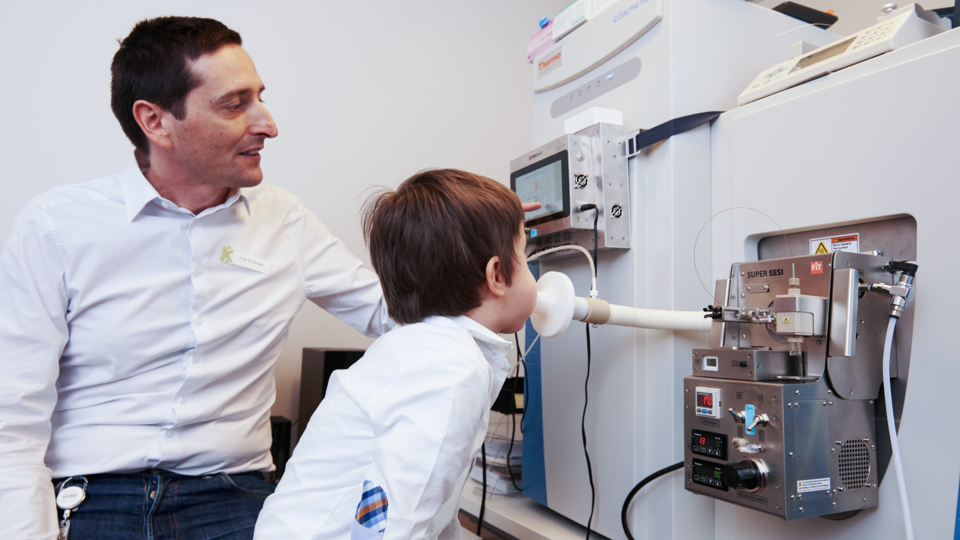
A new method for drug level monitoring developed at the University of Basel and the University Children's Hospital of Basel (UKBB) has been granted a European patent. This innovation enables clinicians to monitor drug concentrations from exhaled breath non-invasively and in real time.
A new standard for clinical practice
The therapeutic management of chronically ill patients proves to be a major challenge in clinical practice, as treatment responses may vary considerably from one patient to another. Traditional drug monitoring relies on invasive blood draws, which may be challenging for pediatric patients and may delay critical treatment adjustments due to processing time.
The patented method offers a different approach. Patients breathe into a mass spectrometer, while a trained mathematical model analyzes the exhaled metabolite profile to predict systemic drug concentrations within minutes. The result is a rapidand painless alternative to conventional monitoring strategies.
This technology has already demonstrated strong clinical potential. In pediatric epilepsy patients at UKBB, the method accurately predicted serum valproate concentrations from breath samples, and has further shown capacity to signal drug response and side effect risk from the same exhaled metabolite profile.
These advances point to the wider applicability of breath-based drug monitoring. Immediate access to patient-specific data, combined with a non-invasive method, opens new possibilities for more personalized pharmacotherapy.
A collaborative achievement
The patent reflects a multidisciplinary effort across researchers and clinicians from the University Children's Hospital von Basel (UKBB), the University of Basel and the University of Zurich.
The Department of Biomedical Engineering congratulates the entire research team on this milestone: Kapil Dev Singh, Amanda Gisler, Martin Osswald, Malcolm Kohler, Johannes van den Anker, Nicolas von der Weid, Urs Frey, Alexandre Datta, and Pablo Sinues.
More about the Translational Medicine Breath Research Group (Sinueslab)