

/ Research
Innosuisse Grant of CHF 890K to Advance the FLOAT Rehabilitation Robot
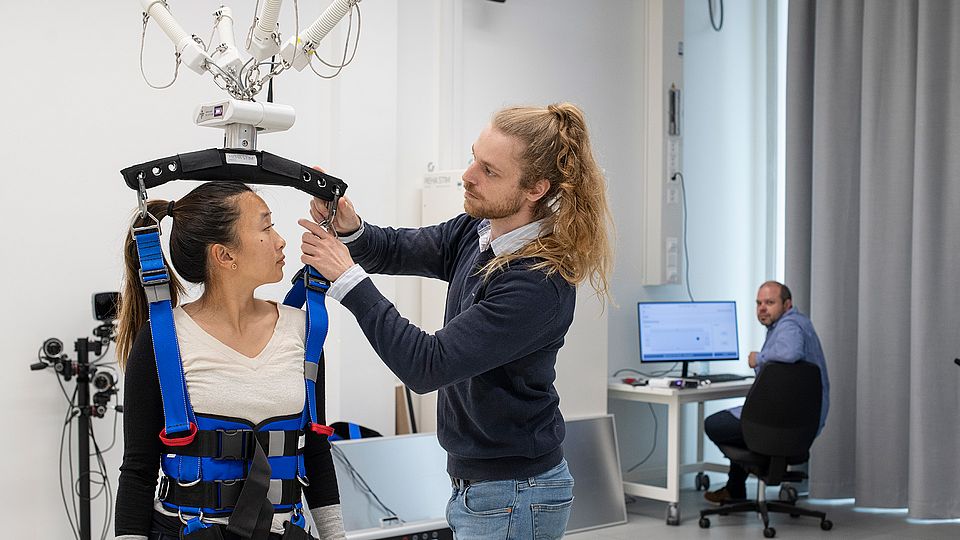
Prof. Georg Rauter and Dr. Lauren Chee, along with industrial and clinical partners, have secured an Innosuisse grant of CHF 890K for the project “Enhancing FLOAT Performance with Intelligent Movement Prediction and Optimized, Activity-Specific Control.”
Conducted in collaboration with the Rehabilitation Clinic of Rheinfelden and the company Reha-Stim Medtec AG, this project aims to further develop the FLOAT, the world’s first medically certified 3D body-weight-support system for overground gait rehabilitation. Already installed in 21 rehabilitation clinics and research institutions worldwide, the FLOAT will be enhanced to benefit a broader range of patients, including children, through new control strategies and advanced clinical assessment tools.
The Innosuisse-funded project aims to significantly improve the transparency and adaptability of the FLOAT through the development of intelligent controllers tailored to different rehabilitation activities, thereby enabling a more natural interaction between the patient and the device.
These advances will allow patients to progress toward increasingly complex rehabilitation exercises that more closely resemble activities of daily living. As a result, the FLOAT will support patients throughout the entire continuum of care, from the early stages of rehabilitation to advanced mobility training.
The results can be transferred rapidly into clinical practice, as the innovations mainly consist of a software update, a new harness equipped with inertial measurement units (IMUs), and updated documentation required for medical device certification.
This new funding highlights the commitment of the BIROMED-Lab and the Department of Biomedical Engineering to translating cutting-edge research into concrete solutions that benefit patients.
More about BIROMED-Lab