

/ Research, Flagship Projects
A Mini Robot to Simplify Dental Treatment
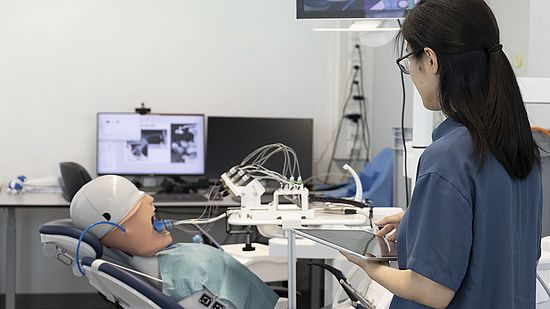

Researchers from the BIROMED-Lab at the Department of Biomedical Engineering have developed a miniature dental robot that could one day automate tooth preparation for crowns. This technology could reduce the number of appointments required for treatment.
Current crown procedures typically involve multiple visits. After removing decay and preparing the tooth, dentists must take an impression before the final crown can be manufactured and fitted at a later appointment. The newly developed robot aims to streamline this process.
The prototype, called MIR (Miniature Intraoral Robot), is designed to prepare teeth precisely according to a digital treatment plan. Following an initial scan, dentists could determine exactly how much tooth material needs to be removed and order the final crown immediately. The scan would also be used to create a patient-specific dental splint that securely holds the robot in place during treatment.
About the size of a wine cork, MIR measures just 43 × 26 × 28 millimeters. Its motors and control system remain outside the mouth and are connected to the robot via flexible drive shafts, cables, and tubes. “It is designed to be small enough to fit comfortably into an open mouth,” says Dr Yukiko Tomooka, first author of the paper in IEEE Transactions on Medical Robotics and Bionics, in which the research team presents the robot.
In laboratory tests on artificial tooth models and ceramic materials with enamel-like hardness, the robot demonstrated a positioning error of less than 0.2 millimeters, despite operating without onboard sensors. The system prepares teeth in two stages, using different milling tools to shape the tooth surface and sides. Researchers also evaluated the forces generated during milling and are investigating noise levels to assess the robot’s suitability for clinical use.
The next development phase will focus on integrating sensors and a camera to enable real-time monitoring of the robot’s position and treatment progress. These additions are expected to further improve accuracy and safety without increasing the size of the device.
The project was developed at the Department of Biomedical Engineering at the University of Basel in collaboration with the Center of Dental Medicine at the University of Zurich, the University of Bern, and Camlog Biotechnologies as part of an Innosuisse-funded initiative.
Read the Uninews
More about the BIROMED-Lab