

/ Doctorate/PhD
New PhD Student Representatives
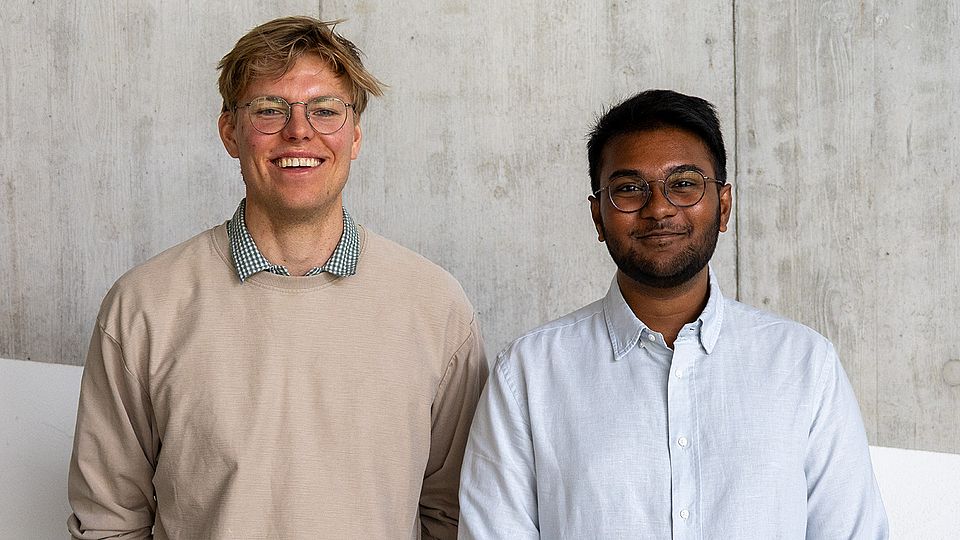
Jan Schimmelpfennig and Sathvik Kadimisetty have been elected as the new PhD student representatives at the Department of Biomedical Engineering (DBE). Coming from international and interdisciplinary backgrounds, both researchers are united by a shared passion for robotics and a strong motivation to strengthen the PhD community at the DBE. In this interview, Jan and Sathvik offer a glimpse into their personalities and share their ambitions for their new role.
What motivated you to run for PhD student representative, and what impact would you like to have in this role?
Jan Schimmelpfennig: I enjoy organizing and bringing people together. The DBE’s interdisciplinary environment offers great opportunities for collaboration, but it can sometimes be difficult to connect beyond our own research groups. Together with Sathvik, I’d like to create engaging social events that strengthen the sense of community within the DBE and encourage more interaction between PhD researchers. We also hope to work closely with the PhD program leaders to make events like the PhD Day and Summer School feel more valuable, interactive, and rewarding for students.
Sathvik Kadimisetty: When I joined the DBE as a non-EU student, navigating everything from scratch was challenging. I was fortunate to have supportive colleagues at the BIROMED-Lab, but connecting with people across the wider DBE community was much harder due to the lack of informal social opportunities. Together with Jan, I’d like to help change that by fostering connections, collaborations, and friendships across the department, without adding extra pressure to students’ workloads.
So that your fellow PhD researchers can get to know you better, could you tell us a bit about yourselves and the journey that brought at DBE?
JS: I completed my Bachelor’s and Master’s degrees in Electrical Engineering and Information Technology at Karlsruhe Institute of Technology, with a focus on signal processing and automation, and spent two years at Grenoble INP - Phelma through a German–French double degree program. An internship in medical robotics at the Zeiss Innovation Hub @KIT sparked my interest in surgical robotics and eventually led me to the BIROMED-Lab through connections with the LASA Lab at École Polytechnique Fédérale de Lausanne where I conducted my Master’s thesis. I am now pursuing a PhD within the SNSF-funded LAROCARE project, where we are developing a laser robot for cartilage implantation in the knee, aimed particularly at helping younger and active patients.
SK: I completed my Bachelor’s in Mechanical Engineering at SRM Institute of Science and Technology in India, specializing in robotics and FEA, before pursuing a Master’s in Robotics at the University of Bristol, where I focused on assistive robotics and human-in-the-loop systems. I later worked as a Research Assistant at CYENS on reinforcement learning for quadrupedal robot control. I then joined the MSCA Doctoral Network in Assistive Health Technology through a project led by Prof. Georg Rauter. My research focuses on developing a situation-aware control framework for FLOAT, a cable-driven body weight support robot.
Could you tell us a bit about yourself on a more personal note —your passions, hobbies, or anything that shapes who you are beyond your PhD work?
JS: I would describe myself as a very active person who enjoys sports and spending time outdoors. In winter, I go skiing, ski touring, and running, while in summer I focus more on cycling and triathlon. I also love travelling and, thanks to my time abroad, have friends all across Europe whom I try to stay in touch with. In quieter moments, I also enjoy relaxing with a good book or a Netflix series.
SK: I’m pretty outgoing and usually end up being the planner on group trips—organizing, coordinating, and making sure everything runs smoothly. I enjoy being involved in every detail, and even when I’m not in charge, I tend to stay curious about what’s going on around me. Growing up in Vizag, India, with its constant sense of discovery, definitely shaped that side of me. At home, I like building things—something I’ve enjoyed since childhood, from Lego to open-source projects. My “build list” is still long, and I’m always adding to it.
Any plans after your PhD?
JS: First, I’d like to take a sabbatical to travel through South America for at least six months. After that, I see myself moving into industry, ideally in an R&D role with a strong engineering focus. Long term, I could also imagine transitioning into project management—and maybe even, one day, contributing to the commercialization of LAROCARE. But one step at a time !
SK: Still figuring it out! I’ve been speaking with people outside academia to understand their experiences and explore which paths might best match my skills and personality before making any decisions