

Cone-Beam CT Artifact Reduction in Dental Implant Imaging
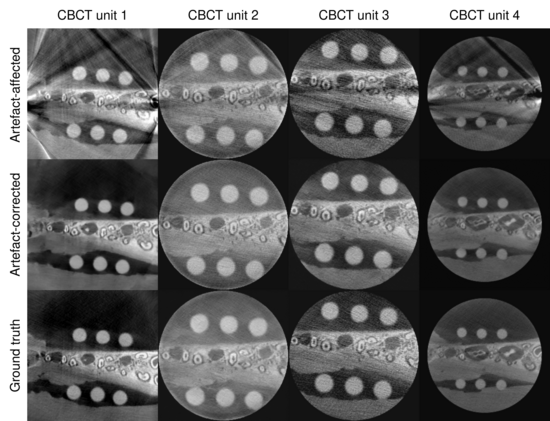
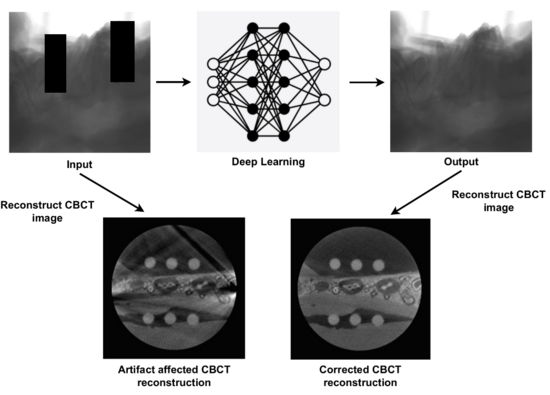
Cone-beam computed tomography (CBCT) is a widely used 3D imaging technique in dentistry, offering high-resolution images while minimising radiation exposure for patients. However, CBCT is highly susceptible to artefacts arising from high-density objects such as dental implants, which can compromise image quality and diagnostic accuracy. To reduce artefacts, implant inpainting in the sequence of projections plays a crucial role in many artefact reduction approaches. Recently, diffusion models have achieved state-of-the-art results in image generation and have widely been applied to image inpainting tasks. However, to our knowledge, existing diffusion-based methods for implant inpainting operate on independent 2D projections. This approach neglects the correlations among individual projections, resulting in inconsistencies in the reconstructed images. To address this, we propose a 3D dental implant inpainting approach based on perpendicular score-based diffusion models, each trained in two different planes and operating in the projection domain. The 3D distribution of the projection series is modelled by combining the two 2D score-based diffusion models in the sampling scheme. Our results demonstrate the method’s effectiveness in producing high-quality, artefact-reduced 3D CBCT images, making it a promising solution for improving clinical imaging.
For more information about this project, please contact Susanne Schaub.

Susanne Schaub

Philippe C. Cattin

Florentin Bieder
Michael M. Bornstein
- Matheus L. Oliveira, University of Campinas, Piracicaba, Brazil
- Yulan Wang, Wuhan University, Wuhan, China
- Dorothea Dagassan-Berndt, University of Basel, Switzerland