

Modeling Disease Trajectories in Age-Related Macular Degeneration Using Generative Neural Networks
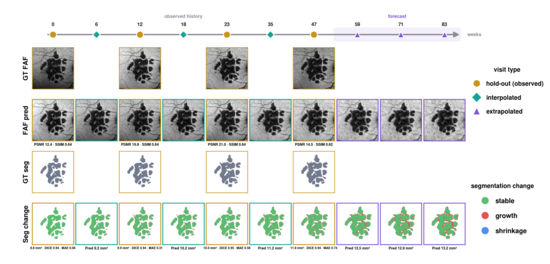
Age-related macular degeneration (AMD) is a leading cause of vision loss, particularly among older adults, and is characterized by two main types: dry AMD, which progresses slowly due to drusen deposits and retinal pigment epithelium (RPE) degeneration, potentially leading to geographic atrophy (GA); and wet AMD, which involves rapid progression due to abnormal blood vessel growth. Current diagnostic and monitoring methods rely on ophthalmic imaging techniques such as optical coherence tomography (OCT), color fundus photography (CFP), and fundus autofluorescence (FAF), but these have limitations in early detection and precision. Machine learning offers a promising approach to improve the prediction of AMD progression by leveraging advanced generative neural networks, including conditional diffusion models (CDMs), flow matching models (FMMs), and implicit neural representations (INRs). These models can iteratively refine images, model anatomical changes over time, and provide more accurate predictions compared to traditional methods. The study aims to develop a multimodal prediction model that integrates imaging and clinical data to enhance risk assessment and enable dynamic predictions that update with each patient visit. The research focuses on two datasets: the OMEGA dataset, which tracks GA progression and provides longitudinal structural and functional data, and the MACUSTAR dataset, which characterizes AMD progression from early to late stages. The aim is to validate these models in real-world settings to improve clinical decision-making and facilitate proactive treatment strategies. The relevance of this thesis lies in its potential to advance early intervention for AMD, reducing vision loss by enabling timely and personalized treatments. However, challenges such as ensuring model interpretability and managing the variability and quality of clinical imaging data must be addressed for a successful clinical application. This research highlights the transformative role of machine learning in ophthalmology and its promise to improve patient outcomes through advanced predictive models.
For more information about this project, please contact Simone Sarrocco.

Simone Sarrocco

Florentin Bieder

Peter M. Maloca

Philippe C. Cattin

Philippe Valmaggia