

MedMCP: An Open Agentic Ecosystem for Medical Imaging Workflows
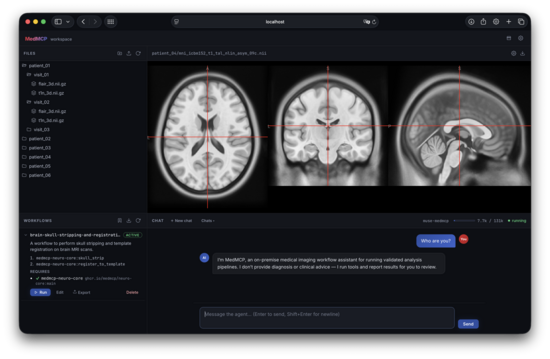
Deep learning methods for medical image analysis now match or surpass expert performance on several benchmarks, and many are released as open source, yet clinicians and medical researchers rarely use them in practice. The bottleneck is not a lack of capable tools but the technical fluency needed to operate them, a gap this project calls the last-mile problem. MedMCP addresses it along two axes: a local agentic workspace that lets users apply state-of-the-art image analysis methods through natural language, and a community-driven tool ecosystem in which developers package their methods as validated, independently testable servers. The framework strictly separates orchestration from execution: a local language model translates user intent into workflow plans and tool calls, while all image processing is delegated to domain-specific tools, so the model never generates code that touches the data. Everything runs on-premise, every side-effecting operation must be approved by the user through a human-in-the-loop permission gate, and a full provenance trail links each output to the tools, parameters, and inputs that produced it. An inspectable workspace with a file explorer and medical image viewer lets users verify intermediate results, and completed sessions can be distilled into deterministic, shareable workflows that re-execute without the agent, including across whole cohorts. The accompanying paper introduces the idea and design principles and is intended as a living document. Further information can be found on the project page: https://medmcp.ai
For more information about this project, please contact Paul Friedrich.
Downloads

Paul Friedrich

Philippe C. Cattin
- Julian McGinnis, Technical University of Munich, Munich Center for Machine Learning, and TUM University Hospital
- Mark Mühlau, TUM University Hospital
- Jan S. Kirschke, TUM University Hospital
- Martin Styner, University of Basel and University of North Carolina
- Daniel Rueckert, Technical University of Munich, Munich Center for Machine Learning, TUM University Hospital, and Imperial College London
- Benedikt Wiestler, Technical University of Munich, Munich Center for Machine Learning, and TUM University Hospital
Supported by the Munich Center for Machine Learning.