

/ Research, People
Three new junior research groups at DBE
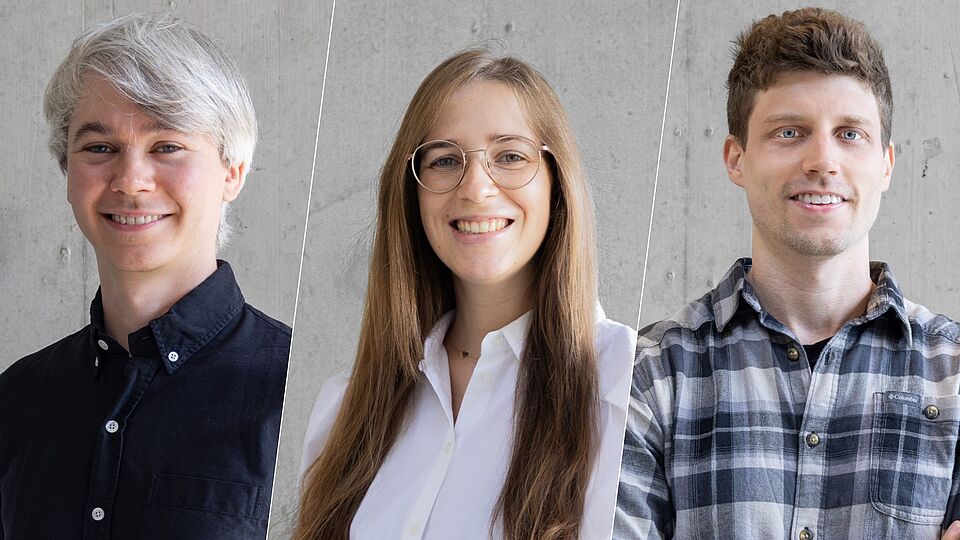
The DBE is proud to announce three new junior group leaders who will lead their own research units at the department. Their work will expand DBE’s research across computational pathology, precision psychiatry and neurology, and quantitative medical imaging.
Maxime Lafarge – Pathology Morpho-Proteomics Lab
Dr. Maxime Lafarge has been promoted to junior group leader under the mentorship of Prof. Viktor Koelzer. He completed his PhD at Eindhoven University of Technology in the Netherlands and conducted his postdoctoral research at the University Hospital Zürich, the University of Zürich and the University of Basel.
As part of the Computational & Translational Pathology Lab, his Pathology Morpho-Proteomics Lab aims to analyzes tissue specimens across cancer types to develop novel prognostic biomarkers, combining whole slide imaging, computer vision and spatially-resolved tissue proteomics technologies.
Magdalena Solyga – Neuronal Biomarkers Lab (NBL)
Dr. Magdalena Solyga joins the DBE as a junior group leader under the mentorship of Prof. Philippe Cattin. Trained as a biomedical engineer at Cranfield University in the UK and Warsaw University of Technology, she completed her PhD at the University of Basel and her postdoctoral training at the Friedrich Miescher Institute.
Her research pioneered VR-EEG approaches to measure predictive processing during natural behaviour in humans. Her Neuronal Biomarkers Lab will develop multimodal biomarkers for precision psychiatry and neurology by combining immersive virtual reality, EEG, and computational modelling.
Marco Barbieri – Quantitative MRI for Musculoskeletal Aging (QM2A) Lab
Dr. Marco Barbieri has been promoted to junior group leader under the mentorship of Prof. Oliver Bieri. Following his PhD in Physics at the University of Bologna, he joined Stanford University as a postdoctoral researcher and later as an instructor, focusing on quantitative MRI for musculoskeletal research.
His Quantitative MRI for Musculoskeletal Aging (QM2A) Lab will develop quantitative MRI methods to study musculoskeletal aging, with a focus on imaging biomarkers for sarcopenia and osteoporosis and their translation toward comprehensive assessment of muscle and bone health.