

Technologies
The CADENCE core facility offers a comprehensive portfolio of technologies designed to provide objective, high-quality data that enhance understanding of movement disorders, improve rehabilitation strategies, and accelerate the translation of innovative solutions into real-world clinical practice. Below, the different technologies are described. Further personalized advanced data analytics and machine learning on movement analysis data may also be provided.
Interested in our services?
Contact us for more details or a price estimation of our services.
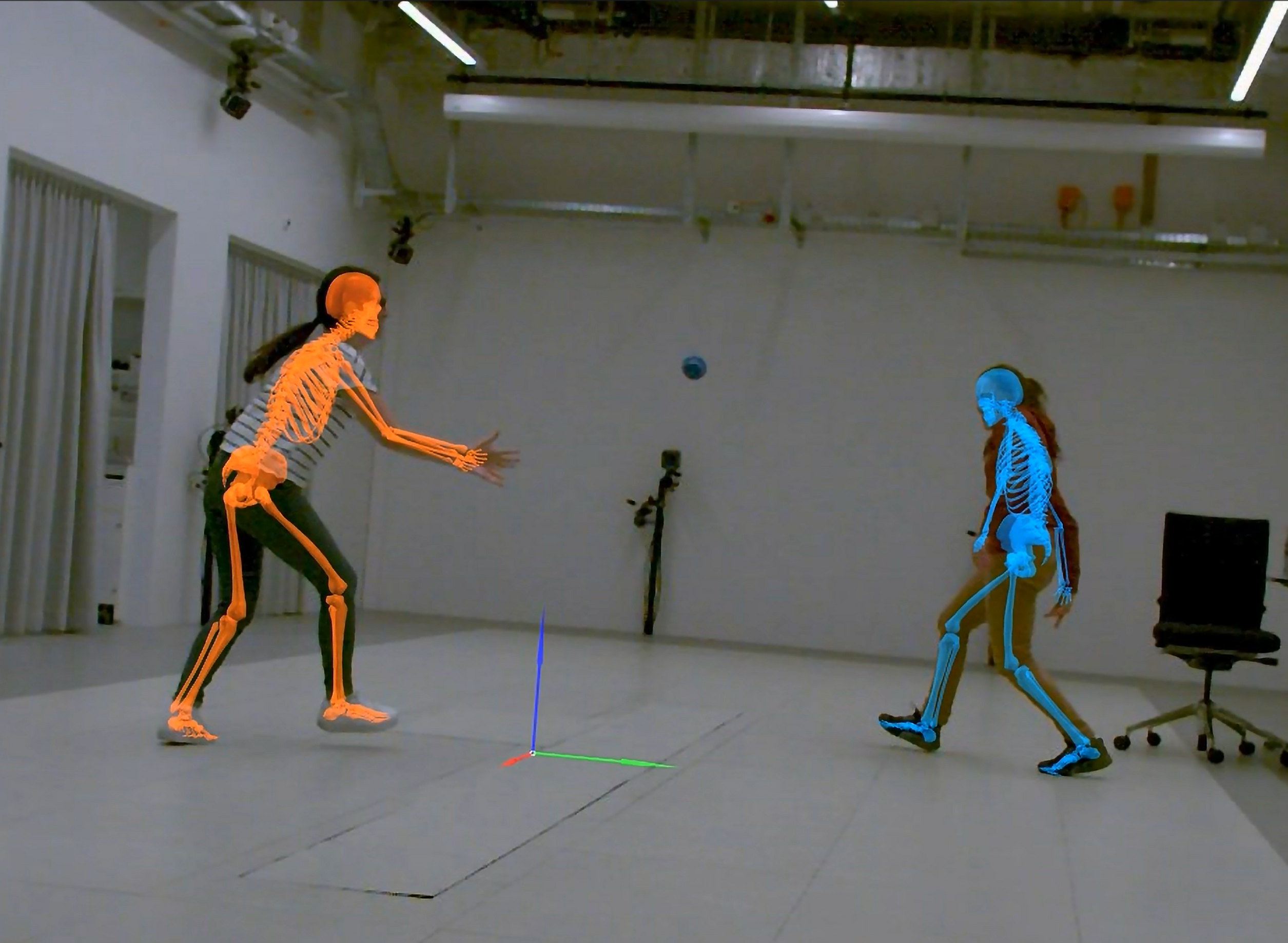
Marker-based, markerless, and inertial measurement unit (IMU) motion capture can be used to analyze movement in studies investigating pathologies affecting the upper or lower extremities. These techniques also help engineers evaluate rehabilitation devices, such as exoskeletons, by quantifying their clinical effects. The CADENCE core facility has expertise in assessing shoulder kinematics using motion capture and comparing results with standard clinical tests, including the empty can (Jobe) test, external rotation lag sign, Hornblower’s sign, and the lift-off, belly press, and bear-hug tests. While these clinical tests provide only subjective positive/negative outcomes based on weakness or lag, motion capture enables objective quantification of movement. Both motion capture methods and clinical tests can be conducted together in the same space.
- Marker-based Motion Capture System (Qualisys)
- Marker-less Motion Capture Systems (Theia)
C. Flierl, University of Basel
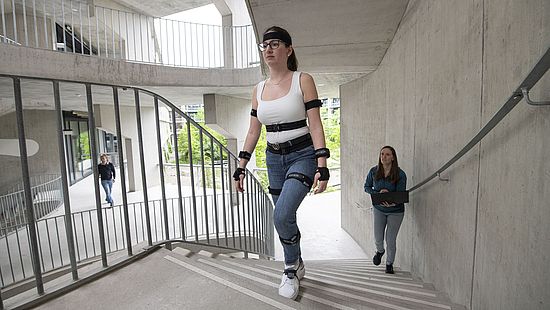
Spastic equinus, or drop foot (EFD), restricts foot movement and significantly impacts daily life, commonly occurring in conditions such as cerebral palsy or stroke. Custom orthoses are essential for providing support and maximizing patient benefit, yet gait assessment is still largely based on visual inspection by orthopaedic technicians. Wearable sensors, such as surface electromyography and inertial measurement units available at the CADENCE core facility, can support the development of sensor-based gait analysis systems to improve orthotic fitting and overall patient care. Because these sensors are portable, they can also be used across various pathologies and enable long-term monitoring both inside and outside the laboratory.
- Electromyography (Noraxon)
- Motion Capture System, Inertial measurement units (Noraxon)
C. Flierl, University of Basel
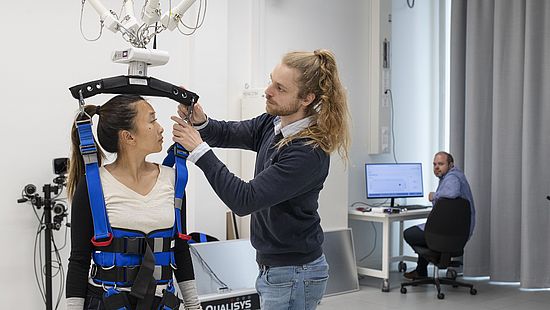
The FLOAT is a rehabilitation robot that provides customized body weight support allowing patients with neurological injuries to begin training sooner after injury. The FLOAT can be used in clinical research to examine the effect of body weight support on gait and rehabilitation outcomes, and in robotics research to explore the control of rope robots. Having this CE marked medical device in a pure research setting will allow for the testing of new control methods and training techniques that can be more seamlessly translated to clinics. The FLOAT can easily be used in combination with other equipment in the CADENCE facility such wearable EMG, IMU, as well as motion capture systems and virtual reality.
- FLOAT (3D-Gait Rehabilitation Robot)
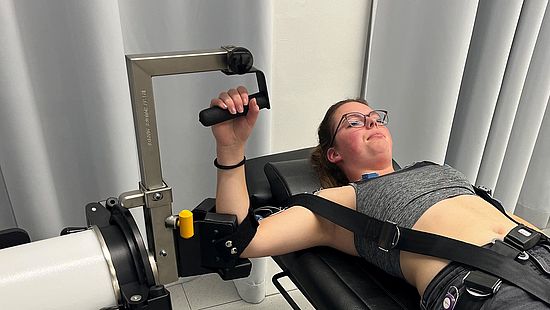
The Humac Norm dynamometer can be used to assess muscle strength of all joints. This is of particular importance for the shoulder joint, as the shoulder is primarily stabilized by the rotator cuff muscles. The rotator cuff facilitates and enables smooth movement of the shoulder, while keeping the glenohumeral joint centralized, thereby providing the large range of motion needed for many daily activities. Assessing muscle strength plays a crucial role in the clinical evaluation of patients not only with musculoskeletal dysfunction, but also with neurological disorders. Furthermore, muscle strength evaluation can be used to monitor patient progress during rehabilitation.
- Humac Norm Isokinetic Dynanometer
C. Fierl, University of Basel
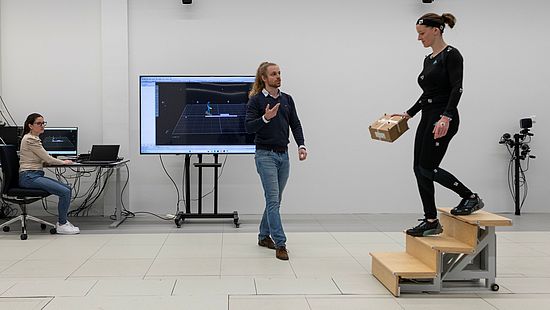
Detailed analysis of loading patterns, movement efficiency, and injury risk in both clinical and sports biomechanics is facilitated by pressure plates, pressure insoles, force plates, an instrumented treadmill, and an instrumented three steps stairs. These devices can be used to assess activities of daily living such as walking or running (upstairs/downstairs, downhill/uphill) or jumping. Pressure plates provide information about pressure distribution across the foot during contact, helping to identify loading patterns and balance characteristics. Similarly, pressure insoles enable plantar pressure to be assessed within the shoe, thereby allowing examinations to be carried out outside the laboratory. Force plates allow to quantify ground reaction forces and moments providing detailed information about how the human body interacts with the ground.
- Force plate (AMTI – seven 40 X 60cm, one 60 x 120cm)
- Instrumented Stairs (AMTI – 3 Instrumented Steps)
- Treadmill Split belt; variable inclination (Treadmetrix)
- Pressure sensitive Plate (Zebris – 2m x 0.6m)
- Pressure insoles (Medilogic + Noraxon)
R. Wendler, DBE
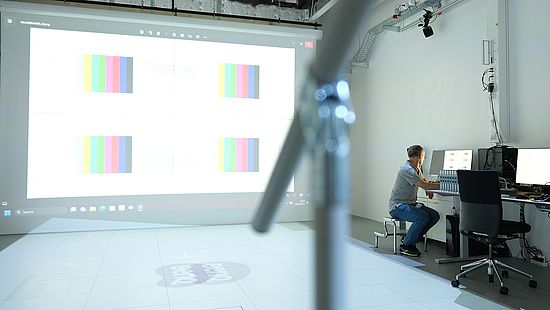
Our floor and wall projection system can be used to immerse participants in a virtual environments for gait training or testing. Floor projection from 4 coordinated projectors at different angles results in projections that avoid shadows and remain immersive. These visual enhancements can be used in combination with any of the other CADENCE technology.
- Floor projection system (Digital Projection E-Vision Laser 9000-WU, Software UNITY)
- 3D Screen projection system (3 x 5m)